
Carnival Of The Liberals # 13 is now up at Lucky White Girl.
Run over there, and follow those links!
Good articles, all. (I think my blogroll is going to get some new blood this week…)
 Three women.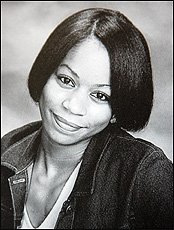
 Three women.
Rachael Entwhistle, 27, murdered in her Hopkington home, with her infant daughter, Lillian. Her husband has been arrested for the murders, after he was extradited from England Dominique Samuels, age 19, murdered and her almost nude body burned in a field behind a local hospital Imette St. Guillen, age 24, a student from Boston, murdered outside a club in the Bowery. A bouncer from that club has been arrested and charged with her murder
Cable talk show hosts and local radio talk jocks tirelessly debated every new development as well as the evidence and motives in the Entwistle and St. Guillen murders. Coverage hit saturation levels.Sadly, there have been enough other cases of “missing/murdered while black” that just slip under the news writer’s notice to dismiss this as just a case of it being overlooked.
Nancy Grace of CNN’s Headline News was among the cable hosts who covered the St. Guillen and Entwistle cases extensively.
Janine Iamunno, a spokeswoman for Grace, said the show’s researchers hadn’t learned of Samuels’ murder until contacted by the Herald yesterday. Grace plans to put the case on her show tonight and cover it more extensively next week, Iamunno said.
A bevy of other cable network hosts, including Greta Van Susteren of Fox News, also extensively covered the Entwistle and St. Guillen cases, but have not addressed Samuels’ murder . A Fox spokeswoman declined comment. ...
… if the national media doesn’t pick up the Samuels murder, “It’s proof to me that there’s something wrong with newsroom managers in terms of how they think about race.
“It’s the same old story with the national media,” Cockfield added. “It’s clear to me that if it’s a white woman who is affected that more attention is paid to than if a black woman is affected.”
 Something is very wrong.
Get an advance prescription for emergency contraception so it will be on hand if you need it, the nation's largest gynecologist group advised women Monday.
The new campaign aims to increase access to the morning-after pill following the Bush administration's refusal to allow the emergency birth control to be sold over the counter nationwide.
"We want women to be prepared, well before a contraceptive failure or unprotected sex occurs. Afterward may be too late," said Dr. Michael Mennuti, president of the American College of Obstetricians and Gynecologists.
 Over on Poor Impulse Control Tata opened up an article with
If you're feeling a bit depressed, skip to the next entry. This one's serious.Which, no matter how depressed I may, or may not, be, is sure to suck me in.
 ...Or maybe not.
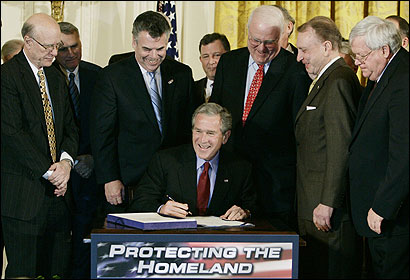 Just days after an article in the Boston Sunday Globe highlighted the massive number of “Signing Statements” that President G.W. Bush has filed on laws he has had some issues with, Senators Arlen Specter (R-PA) and Russ Feingold (D-WI) have called for answers from the White House about number and breadth of the assertions that Pres. Bush has made in the more than 750 signing statements he has recorded since he took office (this represents a rate of about 1-in-10 of the bills signed.), with Specter calling for Senate hearings in June on the issue. (See this article from the 05/03/06 Boston Globe).
At the hearing yesterday, Feingold pressed FBI director Robert Mueller to give assurances that the bureau would comply with provisions in the Patriot Act and to tell Congress how agents are using the law to search homes and secretly seize papers.
Mueller said he saw no reason that the bureau couldn't share that information with Congress. But he also said that he was bound to obey the administration, and declined to promise that he would ''go out there and fight" on behalf of Congress if Bush decided to override the Patriot Act's oversight provision and ordered the FBI not to brief Congress.
[snip]
''How can we know whether the government will comply with the new laws that we passed?" [Feingold] said. ''I'm not placing the blame on you, obviously, or your agents who work to protect this country every day, but how can we have any assurance that you or your agents have not received a secret directive from above requiring you to violate laws that we all think apply today?"
Mueller replied: ''I can assure with you with regard to the FBI that our actions would be taken according to appropriate legal authorities."
 We have heard complaints that President George W. Bush is acting as if he has an “imperial presidency,” of course we cannot forget his remark about how a “dictatorship could be good,” if he were the dictator, and some have pointed to his statements on how his legal staff’s interpretations of the United States Constitution trumps the plain language of what the Congress written into a bill (two of the most publicized are the ban on torture and congressional oversight of the PATRIOT Act).
 Also troubling is the sheer volume of the signing statements. During the elder Bush presidency, the President appended 232 signing statements over 4 years, Bill Clinton appended 140 during his 8 years, and, since the start of his time in office, G.W. Bush has signed at least 750. The accompanying graphic shows the relative absolute count and the average “per year” count.
 March 9, [2006]: Justice Department officials must give reports to Congress by certain dates on how the FBI is using the USA Patriot Act to search homes and secretly seize papers.Bear in mind that we, as citizens, may not even be privy to whether or not a signing statement is being followed into enacting regulations, what the content of some signing statements are, or indeed, if there is a signing statement at all to a particular law, because they would be pertaining to laws that that are, themselves, secret.
Bush's signing statement: The president can order Justice Department officials to withhold any information from Congress if he decides it could impair national security or executive branch operations.
Dec. 30, 2005: US interrogators cannot torture prisoners or otherwise subject them to cruel, inhuman, and degrading treatment.
Bush's signing statement: the president, as commander in chief, can waive the torture ban if he decides that harsh interrogation techniques will assist in preventing terrorist attacks.
Dec. 30: When requested, scientific information ''prepared by government researchers and scientists shall be transmitted [to Congress] uncensored and without delay."
Bush's signing statement: The president can tell researchers to withhold any information from Congress if he decides its disclosure could impair foreign relations, national security, or the workings of the executive branch.
Aug. 8: The Department of Energy, the Nuclear Regulatory Commission and its contractors may not fire or otherwise punish an employee whistle-blower who tells Congress about possible wrongdoing.
Bush's signing statement: The president or his appointees will determine whether employees of the Department of Energy and the Nuclear Regulatory Commission can give information to Congress.
Dec. 23, 2004: Forbids US troops in Colombia from participating in any combat against rebels, except in cases of self-defense. Caps the number of US troops allowed in Colombia at 800.
Bush's signing statement: Only the president, as commander in chief, can place restrictions on the use of US armed forces, so the executive branch will construe the law ''as advisory in nature."
Dec. 17: The new national intelligence director shall recruit and train women and minorities to be spies, analysts, and translators in order to ensure diversity in the intelligence community.
Bush's signing statement: The executive branch shall construe the law in a manner consistent with a constitutional clause guaranteeing ''equal protection" for all. (In 2003, the Bush administration argued against race-conscious affirmative-action programs in a Supreme Court case. The court rejected Bush's view [this is a clear case where the signing statement directly contravenes prior U.S. Supreme Court decisions].)
Oct. 29: Defense Department personnel are prohibited from interfering with the ability of military lawyers to give independent legal advice to their commanders.
Bush's signing statement: All military attorneys are bound to follow legal conclusions reached by the administration's lawyers in the Justice Department and the Pentagon when giving advice to their commanders.
Aug. 5: The military cannot add to its files any illegally gathered intelligence, including information obtained about Americans in violation of the Fourth Amendment's protection against unreasonable searches.
Bush's signing statement: Only the president, as commander in chief, can tell the military whether or not it can use any specific piece of intelligence.
Nov. 6, 2003: US officials in Iraq cannot prevent an inspector general for the Coalition Provisional Authority from carrying out any investigation. The inspector general must tell Congress if officials refuse to cooperate with his inquiries.
Bush's signing statement: The inspector general ''shall refrain" from investigating anything involving sensitive plans, intelligence, national security, or anything already being investigated by the Pentagon. The inspector cannot tell Congress anything if the president decides that disclosing the information would impair foreign relations, national security, or executive branch operations.
Nov. 5, 2002: Creates an Institute of Education Sciences whose director may conduct and publish research ''without the approval of the secretary [of education] or any other office of the department."
Bush's signing statement: The president has the power to control the actions of all executive branch officials, so ''the director of the Institute of Education Sciences shall [be] subject to the supervision and direction of the secretary of education."

