Tuesday, June 18, 2013

On Service

Trailside cairn - Acadia National Park“Do you covet honor? You will never get it by serving yourself. Do you covet distinction? You will get it only as the servant of mankind. Do not forget, then, … why you are here. You are not here merely to make a living. You are here in order to enable the world to live more amply, with greater vision, with a finer spirit of hope and achievement. You are here to enrich the world, and you impoverish yourself if you forget the errand.” 
Woodrow T. Wilson (1856-1924) 

Wilson, a man of strong personal contrasts, the 28th President of the Unites States, is remembered as the man who shepherded the country through WW I and failed at getting the U.S. into the League of Nations.  A Progressive who  attempted to abolish child labor and was a supporter, albeit reluctant, of  woman’s suffrage.  Yet he also instituted strongly segregationist policies in  Federal government administration and was an unrepentant racist., a man who objected to slavery not on moral or humanitarian grounds, but as an attack on labor rights.

The quote above is excerpted from an address Wilson gave at Swarthmore College, in October of 1913.  In that address he exhorts the graduates to forgo the easy path of the privileged, and consider instead the road of sacrifice, very much implying that those who had the privileges of finance and family that enabled them to attend college were somehow intrinsically, rather than by circumstance, more favored than the rest of the citizenry,  and it was their duty to make those sacrifices, playing a "beneficent role" as in Kipling’s White Man’s Burden.

I find this address, and especially the quoted passage, as a case where one can find  commonality of result from wildly disparate foundations, where I find the impulse to Service, to live to the ideal to “enable the world to live more amply, with greater vision, with a finer spirit of hope and achievement” as a logical result of the dictates of Humanism, theistic or not.  As a Christian I am compelled to service, by faith in the concept of humanity as a corporeal expression of God’s existence in the world, where His presence is implicit in every person, no matter the circumstances of birth, wealth or position. Or expressed faith.

The service offered may be working at, or contributing to, a food pantry, the public service that Wilson is exhorting the Swarthmore graduates to,  it may be a :random act of kindness" to a stranger, or something as mundane and unremarkable as erecting trail-side cairns to guide hikers you will never see.  But the act of service itself is something that seems to be called from many, as a part of the human condition.

In the Gospels Jesus exhorts us, the “graduates” of the tradition of two millennia of religious theorizing, to hearken back to the  simple aims He expressed:  to better the world;  to feed the hungry;  to visit the prisoner;  to care for the widow, the orphan and the leper.

 It is our simple duty, as human beings, to do so.

Of course, we need to remind ourselves to watch for the hubris, that overweening pride, of considering that, as Christians, we have some mystical superiority in the reasons for any good works we may do, and feel that the good done, out of simple altruism, by those who are of other faiths, or no faiths at all,  is somehow not as meaningful, or as uplifting.    The Grace offered, and shown, is offered to all, not just those who visibly follow the Law.

“You are here to enrich the world, and you impoverish yourself if you forget the errand.”

Friday, May 24, 2013

Amazing Grace


The news of the world over last few months have been hard ones for many people.

Terrorist bombings in the Middle East. 
The terrorist bombing at the Boston Marathon, and its attendant manhunt.
The murder of a British soldier by zealots.
A seeming never-ending pageant of children killing each other, and themselves, in gun accidents.
The seeming efforts by some politicians to enhance business profits at the expense of the poor, elderly and helpless.
Multiple devastating tornadoes, destroying homes and lives.

A friend wrote that she wished she had a way to filter out the news of murder, hatred and disaster. 

There is so much to trouble, and disturb us.  Where is our limit to be active, and compassionate?  How do we reconcile our duties and responsibilities to be compassionate and active with endless attack, when we reach the threshold of that compassion?  When our strength seems spent?

Over the last decade or so I’ve turned more towards my faith to try to find meaning, and strength.  I have to admit, it’s not always there to find.  

 However, I can often find some peace, at least, from some poetry, or music from that realm.  Amongst that music is one of my favorite hymns, Amazing Grace.  

Likely initially written as a sermon, and later put to music (after several trials the most common music is a recycling of a folk tune called “New Britain”) this is easily one of the best known hymns in the English Language.  But like most hymns, and pretty much all poetry, the search for meaning bears reflection and usually leaves one at several destinations.

Being human, I’m all too aware that I’m imperfect, and, as each of us, holds thoughts and secrets that we fear the rest of the human world to see as ours.  But my faith tells me that those thoughts are not completely unknown beyond my own soul, but are writ boldly before the ken of God.  Yet He still offers me salvation, with love and compassion.  

 No matter that I may feel overwhelmed, He is offering me a support, if only I dare to accept it.   

And with that promise of His unconditional love,  I can feel that I have some peace, and strength, and can, as the saying goes,  be steady and carry on.  

Until the next time.

Amazing Grace, how sweet the sound,
That saved a wretch like me.
I once was lost but now am found,
Was blind, but now I see.
T'was Grace that taught my heart to fear.
And Grace, my fears relieved.
How precious did that Grace appear
The hour I first believed.
Through many dangers, toils and snares
I have already come;
'Tis Grace that brought me safe thus far
and Grace will lead me home.
The Lord has promised good to me.
His word my hope secures.
He will my shield and portion be,
As long as life endures.
Yea, when this flesh and heart shall fail,
And mortal life shall cease,
I shall possess within the veil,
A life of joy and peace.
When we've been here ten thousand years
Bright shining as the sun.
We've no less days to sing God's praise
Than when we've first begun.
Amazing Grace, how sweet the sound,
That saved a wretch like me.
I once was lost but now am found,
Was blind, but now I see.
( The sixth verse was added to the song by Harriet Beecher Stow, in her novel Uncle Tom’s Cabin, from a spiritual called “Jerusalem, My Happy Home”)

Tuesday, May 07, 2013

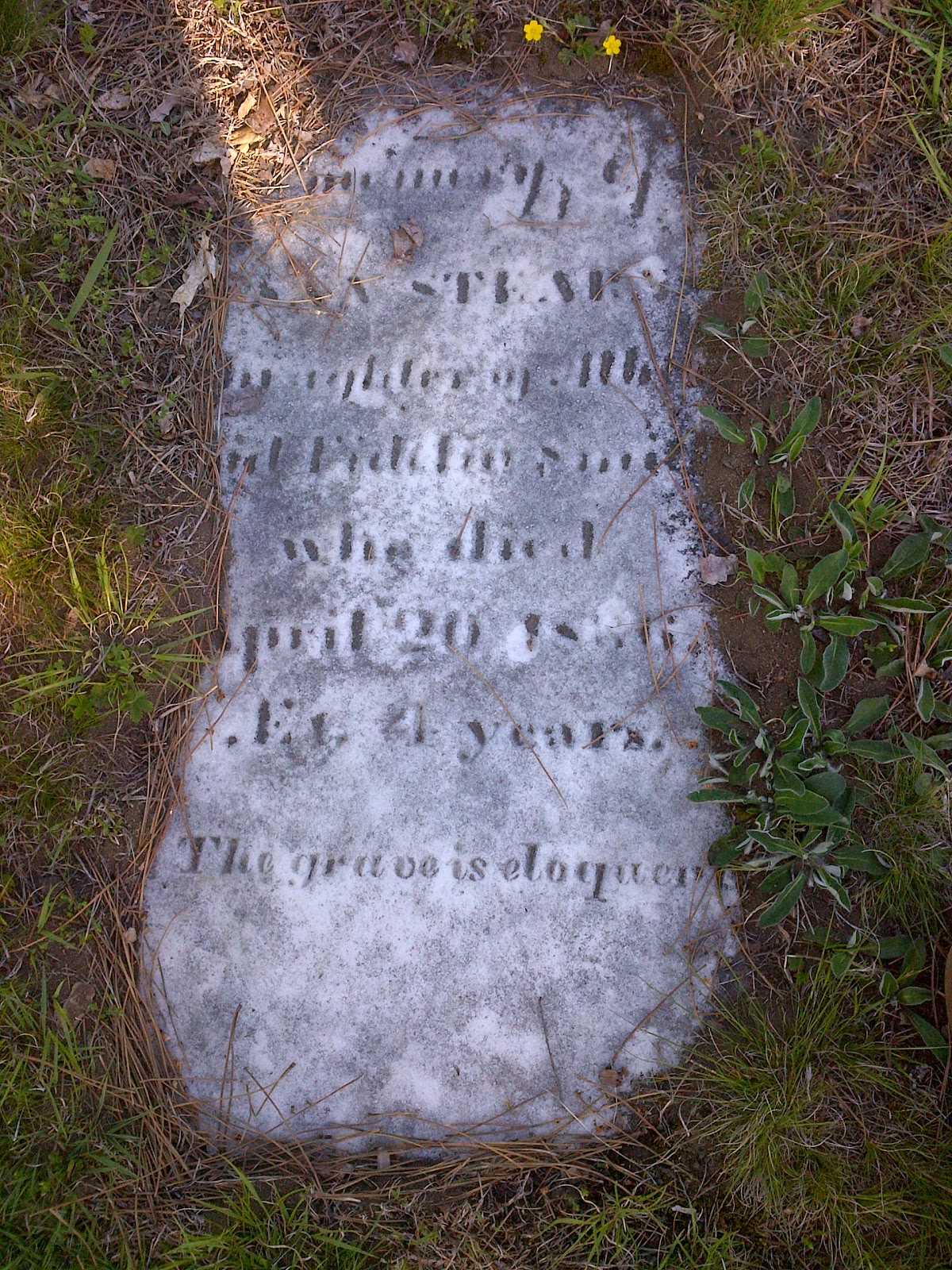
"The Grave is Eloquent"

That was something that I recently saw on a nineteenth century grave marker in Leominster, MA.  The grave marker commemorates the death, in 1836, of a 4-year old girl named Susan.  The marker doesn't tell much of Susan, just the date and that her family felt compelled to inscribe her stone with "The grave is eloquent."

"The grave is eloquent."

Were they devastated by her death, and saw the hopeless silence of the earth the telling state?

Was she the victim of lingering pain, and the grave the peace she was released to?

Were they Christian, and saw the expressed hope of Christ's empty tomb as their prayer for reunion at the resurrection?

"The grave is eloquent."

We don't know much about Susan, just her age at passing, where she was interred and that someone thought that more than just the dates were called for, but chose to ponder other than her brief life here.

"The grave is eloquent."

This is what Susan's family, those responsible for her in death, as in life, felt was right. 

Right for her. 

Right for them.

Today, there is controversy over the burial of a 21st century person.  One Tamerlan Tsarnaev.

There were protests outside the funeral home that accepted Tsarnaev as soon as the location was made public.

Calls for burning the ashes and spreading them randomly.

Calls for burial at sea.

Statements from civic leaders that he should not be buried "here," for almost any value of "here" in the U.S.

The funeral director has inquired all across the country, but the answer is always "not here."

Very little thought is given to what would feel right for the family. 

Those who knew the little boy Tamerlan when he was aged four years. 

Who saw him grow. 

Who sent him to school. 

Who took him to worship.

Who saw the evidence of his crime, and the evidence of his death, on television.

I have always been an American.  Usually I've been proud of that.  Not always, but usually.

This is not a time I'm altogether proud of my nation.

I'm ashamed that both the candidates for U.S. Senate for Massachusetts have said "Not here" instead of  "we grieve with all the families."

This isn't about scoring points in some game of pandering to the bigotry of hate.

Funerals aren't really for the dead, they're for the living.  Those left behind.

We need to have compassion for those families who have lost.

All the families. For all the victims.

Compassion, and mercy, are not weakness, but strength.

The mother of this boy thinks she may want to take the boy back to Russia, where he grew up.  His uncle thinks that he should be buried here, as Tamerlan Tsarnaev made the Unites States his home for 10 years.

By the time you read this, the decision may have been made, and the body interred.

But where, and how, will be a telling sign for us all, as a nation.

A sign of our strength, our compassion, our mercy.

"The grave is eloquent"

Sunday, April 28, 2013

Thomas' Faith

I recently was part of a small group that re-affirmed baptismal vows.

As part of that process, we met with the Bishop of our Diocese.  One of the things he asked us all, was to think on what Biblical story  we found most resonant for us.

Some found the resurrection at the tomb most important, others the story of Lazarus,  others still the parable of the Good Samaritan.

I realized that I really hadn't thought on what would be the most telling for me.

As I thought, the story that crystallizes my faith is that of Doubting Thomas.

Like many of the stories and parables in the New Testament,  this story can be viewed on many lights.  One of the advantages of a non-literal Bible tradition is that one can explore these different levels, and  we can view each of those as valid for discussion and contemplation.

The most common illumination of this story is the faith of the people who had not seen the visitation, yet still believed in the resurrection, unlike Thomas, who said "Show me."

What I find important in this tale is the circumstances involved.

In many cases, if one expresses doubt in The Faith, one is chastised or shunned.

Or the doubts force the doubter away, as they feel they have no place with those they may break from.

In this case, however, the week after the visitation that Thomas missed, he again met with the other disciples.

Those who had seen did not tell Thomas to go away because he did not believe, but welcomed him as their brother still.

Thomas himself did not cut himself from that community, either because he did not know where else to go, or he still hungered for the validation, at least second-hand, of his prior faith, or he still hungered for that faith itself.

When the Savior appeared again, He offered Thomas the chance to feel for himself the wounds, in order to prove the reality.  This was not done in spite or rebuke, but to show Thomas that he was still loved and wanted as a part of Christ's family, and that any proof would be offered gladly.

As someone was was unchurched for quite a while, this story, along with the parable of the prodigal son, speaks to me dearly, as reaffirmation that those who leave will be welcomed anew, with celebration and love.

Tuesday, April 23, 2013

Stones of Remembrance and Five Victims

I'm a Christian. 

One of the bedrock tenets of Christianity is forgiveness.

Asking forgiveness for our own deeds; giving our own forgiveness for deeds done against us; praying for forgiveness from G/d for all who trespass.

This forgiveness does not mean that those who transgress are not to held accountable for their actions. It means that any accounting be done for justice and mercy, not retribution and vengeance.

Since the bombing at the Boston Marathon I've been trying to pray, sincerely, for forgiveness for those responsible.

Being a lifetime Bostonian, someone who occasionally stood in the crowd to see the finishers, this crime has relevance for me. It has especial resonance because, when I worked for the old John Hancock Insurance company, I worked as a volunteer on, and around, the finish line of the race.  

I wanted to pray for that forgiveness, but kept feeling for vengeance. Once the two brothers were identified it was even harder to ask for that forgiveness.

This bombing was not an unimaginable act, for it was conceived and acted upon. But it was heinous, hateful, odious, abominable, totally reprehensible.  More so, parochially,  since it was my birth city.  Now I had faces to see as those responsible.
   
And I wanted so, as a Christian, to pray for that forgiveness. But what I kept feeling for was that revenge.

In the "modern" Christian churches that embrace it, the rite of Confirmation, by those who have attained "the age of reason," the corporal purpose is a conscious reaffirmation of one's membership in the church, and the responsibilities that entails. (We'll leave for another day the theological underpinnings).

At my church, during this past Saturday night's meeting with our pastor, the candidates for Confirmation & their sponsors made a small memorial table up in the sanctuary for the 3 people killed by blast at the Marathon finish line and the MIT policeman shot and killed by the bombers.

At regular services on Sunday all were asked to place a pebble  on the table with the memorial, instead of flowers, in the tradition of the Jewish Stones of Remembrance.

One of the sponsors told that, as part of the group's prayers after setting up the table, they struck a bell 4 times, once for each victim. However, once the bell was struck only a glancing blow and did not ring true, so had to be struck again.  She said one of the teenage candidates told her that it was a reminder that there were five victims killed as a result of this tragedy, not four.

That teenager had grasped the essence of her responsibility as a Christian, to forgive.  Something I had found so hard to do. That fifth person was also of G/d's family, as are all of us.

That desire for vengeance is still in me.

But now, I hope, I can truly pray for forgiveness.


I'm a Christian

Wednesday, April 17, 2013

"Be Ye Not Afraid" (Deut. 1:29)

Yesterday (April 17, 2013) the national Parliament of New Zealand had a final vote on their Definition of Marriage bill, which passed on a vote of 77 to 44.  This makes NZ the 13th nation to legalize marriage equality.

This may still be overturned by citizen referendum.  However, from the {admittedly small) number of New Zealand citizens I know, it would not be at all certain that anything even close to an overturn would occur.

One of the MPs, Maurice Williams gave a wonderful (and lighthearted) speech in support of the bill.

A telling quote, that can be heard all around this country as well, from those favoring equality in marriage rights was: "I give a promise to those people who are opposed to this bill right now... the sun will still rise tomorrow, your teenage daughter will still argue back with you as if she knows everything, your mortgage will not grow, you will not have skin disease or rashes or toads in your bed."

Just as, here in Massachusetts, the legions of Hades have not come forth from the Sumner or Ted Williams tunnels, nor has the State House dome collapsed from divine retribution.


Here, from the magic of YouTube, is that MP's speech.  And he closed his address with the above paraphrase from the book of Deuteronomy.

"Be ye not afraid"
 

Tuesday, April 16, 2013

But For The Grace


We are all G/d's children.

 There is an old saw: "There, but for the Grace of G/d, go I." 

The usual accepted meaning is that there are, for all but the select few, always those who are worse off: in material wealth or physical or spiritual health. 

 What I'd rather think is that, as we have been granted that sufficiency of that Grace, it is beholden on us to pass it forward - if we received it once, whether that Grace will be replenished or not is immaterial. 

Recently, some members of the Episcopal congregation where I am welcomed worked, as part of their outreach and witnessing, assisting the regular members of the Worcester Fellowship on their Sunday lunch and worship, held on Worcester Common ("Worship at 1 PM Sundays, Rain or Shine"). 

This fellowship group gives lunch, socks, fruit and bread to anyone who comes, poor, "genteel" or homeless, no questions asked. Followed by a non-specific Christian service, with no requirement to participate, listen or even stay. The only requirement is that, if you hunger, you partake.  Either of the bag lunch or the service.  Or both.   Wherever your hunger is.

For our congregation, it was a "field trip" for the candidates for Confirmation and those of us considering reaffirmation of our Baptismal covenant. I've helped in such occasions before, but for for quite a while, and usually in a much more secular context. 

Among the persons the fellowship serves are the gamut of what our modern society either ignores, lets slip through the strands of the "safety net" or outright rejects. I've heard, again and again, that it's "their own fault," or "their own decision" to be in the straits they are. 

"They're homeless by choice."  
"He's just too lazy to get a job"
"She's just crazy"
"If she's a runaway she can always just swallow her pride and go back home"
"If she can't work 'cause she can't afford child-care she shouldn't have had those kids"
"It's not *my* fault he went to prison and now can't find work"

 And if you hear it often enough, you begin to believe, and you are willing to harden your heart. After all, we can't save everybody, now can we? There are just so many of them.

But. 

Once we see these people, how can we, any of us, whether Christian, Jewish, Muslim, Zoroastrian or atheist, not help? 

The man who received his seven miracles that changed his life, the woman who was afraid that she didn't "deserve" to have a pastry while in line for a sandwich, or the father with his deaf daughter who couldn't contain herself when offered a second doughnut hole?

How can we not at least offer that help, as best we can? 

The despair is that we, as individuals, can make such a small difference. 

But.

As individuals we don't have to work alone.  Together we can work miracles.  Yeah, they may be small, itty-bitty miracles, but get enough small ones and maybe the light gets a little brighter for the rest.

Many people come to working with the people we should remember through their churches, and move to political awareness or action from that springboard.  I kind of got it backwards.  My upbringing as a "left behind" Roman Catholic (and extremely "lapsed" as well) informed my choices as a "progressive" after I grew out of the childhood of "conservatism," and my re-entry to the active Christian community was that progressive bent helping me to find the spirituality, and recognition of faith again.

But.  But.

This is arguably the richest nation in the world.  How do we even tolerate that programs like soup kitchens and food banks or bag lunches on the Common are needed?

Oh, right.  I forgot.  "It's their own fault."