Monday, November 25, 2013

"..Miles to go before I sleep.."

Scribed into a granite panel at the JFK Library in Dorchester, MassachusettsFifty years ago this week occurred one of the defining moments of all who experienced it, whether it was realized at the time or no.

I refer, of course, to the assassination of President John F. Kennedy.

It's one of those moments when, if asked, you will always remember. 

Some will remember television or radio broadcasts.

Some reporters remember hearing of his death from the priest who administered the sacrament of Last Rites.

Others remember hearing of the death during a Boston Symphony concert, when Erich Leinsdorf, the then Music Director of the Boston Symphony Orchestra, announced to an afternoon audience of concert-goers, and changed the program to play the Funeral March from Beethoven's Third Symphony.

The musicians in that orchestra will remember that they heard of it as the music librarian was distributing copies of the music for the changed program, from whispered words from that librarian.

On that date I was just a few weeks past my eleventh birthday, and didn't fully grasp why we had all been let out of school early that day.

It was not until much later that I appreciated the import of that day, not for the assassination itself, but in the legacy that was left behind from his administration, and for the potential that had been stolen from the nation..

Part of that legacy was the feeling that someone who was not one of the "elite" could represent the nation from that chair in the Oval Office.  It didn't matter to us that he came from a wealthy and influential family.  It didn't matter that he went to a prep school and went to Harvard.  He was from Irish stock from Brookline.  It diden't matter that his family lived for years in New York.  He was still "one of us" a  Massachusetts boy.

Even more momentous, he was a Roman Catholic at a time when some expressed  fears that he would take secret orders from the Pope.

All of these changes felt like they were the proverbial winds of change, opening up a new world for the country, where we felt that we could do great things, both as a nation, and as an individual.

The years that saw the Peace Corps with individuals making a difference, and the start of the Apollo space program, showing what we could do, as a nation.

There were missteps.

The Bay of Pigs. 

The reluctance to push for meaningful Civil Rights legislation, for fear of losing the southern Democrat voting block. 

But he did start work of landmark legislation, which was only enacted after his death. PBS commentator and producer Callie Crossley remembers that, as she was growing up, most black families had a commonality of three pictures on their walls: Jesus Christ; Dr. Martin Luther King, Jr. and John Kennedy.  These were all men who had given their lives and their opportunity for the betterment of others.  And all three had been taken from the world in their prime.

When I was growing up, and in college, and when I started working, I felt that the ideas of fairness and opportunity for all had become a part of the normal fabric of our society, where what you could do far outweighed where you came from, or who you knew.

I guess I always knew, when I would admit it to myself, that the truth was that for true advancement it was who you knew, rather than what you could do.  But there were opportunities opening up, even if not as truly egalitarian as we had hoped and believed.

Perhaps now we are more cynical, or realistic, when state unemployment counselors now coach on how to build "networks," over how to best present your skills in a cover letter or in an interview.

Who you know.

We know that it wasn't really that perfect a time.  But we hoped.  And we were inspired.

Kennedy was friends with Poet Laureate Robert Frost,  and would quote from Frost in his addresses.

I'll close here with some lines from Frost, from a poem of his that often brings me to think on potential that is otherwise unseen:

"The woods are lovely, dark and deep.
 But I have promises to keep,
 and miles to go before I sleep,
 And miles to go before I sleep."


Monday, October 28, 2013

Stillness, in motion

Our modern world demands our time, our energy,
our identity.


We navigate through our lives, 

   immersed into technology,
  demands that we subsume our individuality,
   to stay within the flow of traffic,
  commerce.

Too often we leave ourselves behind, 

  caught in the whirlpool, 
  losing sense of ourselves, 
  individual,
  not just parts in the machine.

Slow down,

  remember,
 recover who we are, 
 contemplate the breathing of a sleeping child, 
 wonder in the promise of the sleeping seed. 

=============================
"Muddy water,
let stand,
becomes clear.”
― Lao Tzu

Sunday, October 27, 2013

Hiding In Plain Sight

First marriage.

Out of work for 18 months

2 kids, one 4, the other a toddler of 2.

It doesn't feel like "charity," 'cause you're helping with the paperwork and stocking/distributing.

It was run out of the church basement, and you listened, without saying anything, from people who at least had work, when they talked about how stupid the nuns were who were administrating the project, "stupid" 'cause they were certain that most of the recipients were just faking it and didn't need the groceries.

 And besides, even if they did need the groceries, what kind of person has so little pride that they would take charity.

And besides, why didn't they just get a job, furchristssake?

 If they're that poor, or unemployed for so long, it's gotta be their own fault, right?

Didn't say anything, so they wouldn't know that the frozen hot dogs, and the mac & cheese and ramen noodles and the cans of peaches and pineapple rings and condensed soup and the Spam came out of that church basement, along with the blocks of US agency surplus cheese.

So they wouldn't know what it felt like when you waited 'till all the (other) "clients" had left and gone home, before you put a cardboard box into the trunk of the car.

 So those single moms, and teen moms, and those dads out of work, or those grandparents raising their grandkids, or those who were working under the Golden Arches for 15 hours a week or the kid who got sold on the idea that he/she didn't need school and dropped out at age 17 and couldn't figure out the logistics of finding time to study for the GED wouldn't know.

Couldn't let them, of all people, find out that the guy with a couple of years college who talked nice  and could help them fill out the forms was in the same leaking boat.

That wouldn't do at all.

Gotta have some pride.

The economy got better, and jobs came along again.

And you try to forget what it felt like.

But you never really do forget.  Especially when you had had been brought up to believe that as The Husband and The Father that it was your job to make sure the food was on the table, and taking handouts was just, well, wrong.

 Just as well that the economy got a lot better quickly, as the donations were getting smaller and smaller.

Either because the people who had been giving were getting short themselves, or they were getting tired of seeing that the client list at the church basement never got any smaller.

At some point it dawned on The Powers That Be that there were Structural Issues.  It least the feds and some of the states woke up to the fact that the churches and private charities couldn't handle the load, 'cause there were too many people poor, and too little in the way of resources.

But still, unless you catch someone using a benefit transfer debit card at the supermarket, or you see the aid voucher at that checkout you can't tell.

And you don't want anybody to know.

It's 35 years later, and you wonder, sometimes, whose doing the extra paperwork and stocking the shelves at the pantry so they can say "it ain't 'charity,' I'm working for it."

Gotta have some pride.
.

Wednesday, July 17, 2013

On "Libertarian Economics"

(The following is based on a response to a thread on Bruce Coville's Facebook page on the AMERICAN CONSERVATIVE's view on the House GOP's leadership and members decision to decouple the SNAP program funding from the 5-year authorization for the Farm Bill.)

 In a society where millions of Americans must rely on food stamps to feed their families, and it is estimated that over $100 Million dollars worth of SNAP benefits will be redeemed this fiscal year in the military commissary system, overwhelmingly by active-duty service people, this decision is bankrupt.

 The most repeated justification relies on the (thoroughly discredited) Chicago School of Economics, sometimes referred to as "libertarian economics." (BTW, how do you "discredit" an economic theory? By looking at what it predicts will happen, and seeing that that prediction has no relationship to what really happens)

Aside from its fundamental unsoundness (that is, it doesn't work), "libertarian economics" has another deep flaw, that shows from both a practical and a moral perspective: the "libertarian" aspect. The fundamental idea of the libertarian model is one of absolute independence from "forced" obligation and "forced" cooperation, in both the private and public spheres, and that the somehow (voluntary) cooperative forces of the unfettered "free market" will somehow lift all boats (or at least those boats that are somehow "worthy")

. The practical, and logical, examples of this libertarian "independence" can be seen in the utter failure of the austerity programs being forced into implementations as preconditions to monetary aid from either the World Bank or the IMF. They simply do not do the job of lifting those targeted economies for any but the well-heeled individuals and institutions that will be insulated enough to weather this imposed economic chaos, and, after a suitable waiting period, can buy up all the remaining assets at desperation fire-sale prices.

 The logical political extension of this Libertarian ideal of "small government" and "self sufficiency" can be seen in failed states like Somalia - and the society is dominated solely by those who have access to the biggest private armies, and an dictate allocation of resources on a whim. That is what happens when you have drowned the government in the bathtub.

 My objection to this brand of economics from a subjective moral standpoint stems from, I will admit, my personal upbringing as a Christian. The aforementioned fundamental Libertarian "independence" presupposes a degree of isolation and voluntary suspension of empathy that is, for a Christian, unsupportable. The forcible imposition of immense hardship on those least able to weather it, in the appeasement of any sense of righteous indignation that someone, somewhere, that is "not worthy" or "lazy" or "made bad decisions" might "get a free ride" doesn't, from a Christian moral perspective, float any boats.

 And that sense of indignation for those who are "unworthy" breeds a suspension of empathy that lets one ignore that these are real people receiving those food stamps, or that unemployment check.

The sense of outraged privilege that says that, because someone, somewhere might be buying a circle of shrimp with a SNAP card that children and families in another part of the country must be punished.

The sense of outraged privilege that thinks it makes good economic sense to have "anti-fraud" programs that cost twice as much to administer than they can ever hope to recover, because the touted excessive fraud is not there.

The sense of outraged privilege that seems to think that someone receiving unemployment insurance (UI) benefits must be denied the dignity of not being pauperized (and maker no mistake - the pay-rate of salary paid to an employee has the cost of UI premiums built into it -- that premium payment may be administratively paid be an employer, but it comes out of the employee's pocket)

 The whole basis for these "libertarian" ideals is, on a practical basis, unworkable in the modern world, where everything from the cost of gasoline to the yield of Palouse wheat or Aroostook Country potatoes are all interconnected and interdependent.

From the secular societal standpoint, the guiding corollary to Rousseau's social compact is that those who enjoy the benefits of cooperation and protection in that society owe a duty to others in that society to extend them the same benefits.

Or to put it more simply, especially for those who profess to be Christian: "Do not rob the poor because he is poor, Or crush the afflicted at the gate" (Proverbs 22:22)

Tuesday, June 18, 2013

On Service

Trailside cairn - Acadia National Park“Do you covet honor? You will never get it by serving yourself. Do you covet distinction? You will get it only as the servant of mankind. Do not forget, then, … why you are here. You are not here merely to make a living. You are here in order to enable the world to live more amply, with greater vision, with a finer spirit of hope and achievement. You are here to enrich the world, and you impoverish yourself if you forget the errand.” 
Woodrow T. Wilson (1856-1924) 

Wilson, a man of strong personal contrasts, the 28th President of the Unites States, is remembered as the man who shepherded the country through WW I and failed at getting the U.S. into the League of Nations.  A Progressive who  attempted to abolish child labor and was a supporter, albeit reluctant, of  woman’s suffrage.  Yet he also instituted strongly segregationist policies in  Federal government administration and was an unrepentant racist., a man who objected to slavery not on moral or humanitarian grounds, but as an attack on labor rights.

The quote above is excerpted from an address Wilson gave at Swarthmore College, in October of 1913.  In that address he exhorts the graduates to forgo the easy path of the privileged, and consider instead the road of sacrifice, very much implying that those who had the privileges of finance and family that enabled them to attend college were somehow intrinsically, rather than by circumstance, more favored than the rest of the citizenry,  and it was their duty to make those sacrifices, playing a "beneficent role" as in Kipling’s White Man’s Burden.

I find this address, and especially the quoted passage, as a case where one can find  commonality of result from wildly disparate foundations, where I find the impulse to Service, to live to the ideal to “enable the world to live more amply, with greater vision, with a finer spirit of hope and achievement” as a logical result of the dictates of Humanism, theistic or not.  As a Christian I am compelled to service, by faith in the concept of humanity as a corporeal expression of God’s existence in the world, where His presence is implicit in every person, no matter the circumstances of birth, wealth or position. Or expressed faith.

The service offered may be working at, or contributing to, a food pantry, the public service that Wilson is exhorting the Swarthmore graduates to,  it may be a :random act of kindness" to a stranger, or something as mundane and unremarkable as erecting trail-side cairns to guide hikers you will never see.  But the act of service itself is something that seems to be called from many, as a part of the human condition.

In the Gospels Jesus exhorts us, the “graduates” of the tradition of two millennia of religious theorizing, to hearken back to the  simple aims He expressed:  to better the world;  to feed the hungry;  to visit the prisoner;  to care for the widow, the orphan and the leper.

 It is our simple duty, as human beings, to do so.

Of course, we need to remind ourselves to watch for the hubris, that overweening pride, of considering that, as Christians, we have some mystical superiority in the reasons for any good works we may do, and feel that the good done, out of simple altruism, by those who are of other faiths, or no faiths at all,  is somehow not as meaningful, or as uplifting.    The Grace offered, and shown, is offered to all, not just those who visibly follow the Law.

“You are here to enrich the world, and you impoverish yourself if you forget the errand.”

Friday, May 24, 2013

Amazing Grace


The news of the world over last few months have been hard ones for many people.

Terrorist bombings in the Middle East. 
The terrorist bombing at the Boston Marathon, and its attendant manhunt.
The murder of a British soldier by zealots.
A seeming never-ending pageant of children killing each other, and themselves, in gun accidents.
The seeming efforts by some politicians to enhance business profits at the expense of the poor, elderly and helpless.
Multiple devastating tornadoes, destroying homes and lives.

A friend wrote that she wished she had a way to filter out the news of murder, hatred and disaster. 

There is so much to trouble, and disturb us.  Where is our limit to be active, and compassionate?  How do we reconcile our duties and responsibilities to be compassionate and active with endless attack, when we reach the threshold of that compassion?  When our strength seems spent?

Over the last decade or so I’ve turned more towards my faith to try to find meaning, and strength.  I have to admit, it’s not always there to find.  

 However, I can often find some peace, at least, from some poetry, or music from that realm.  Amongst that music is one of my favorite hymns, Amazing Grace.  

Likely initially written as a sermon, and later put to music (after several trials the most common music is a recycling of a folk tune called “New Britain”) this is easily one of the best known hymns in the English Language.  But like most hymns, and pretty much all poetry, the search for meaning bears reflection and usually leaves one at several destinations.

Being human, I’m all too aware that I’m imperfect, and, as each of us, holds thoughts and secrets that we fear the rest of the human world to see as ours.  But my faith tells me that those thoughts are not completely unknown beyond my own soul, but are writ boldly before the ken of God.  Yet He still offers me salvation, with love and compassion.  

 No matter that I may feel overwhelmed, He is offering me a support, if only I dare to accept it.   

And with that promise of His unconditional love,  I can feel that I have some peace, and strength, and can, as the saying goes,  be steady and carry on.  

Until the next time.

Amazing Grace, how sweet the sound,
That saved a wretch like me.
I once was lost but now am found,
Was blind, but now I see.
T'was Grace that taught my heart to fear.
And Grace, my fears relieved.
How precious did that Grace appear
The hour I first believed.
Through many dangers, toils and snares
I have already come;
'Tis Grace that brought me safe thus far
and Grace will lead me home.
The Lord has promised good to me.
His word my hope secures.
He will my shield and portion be,
As long as life endures.
Yea, when this flesh and heart shall fail,
And mortal life shall cease,
I shall possess within the veil,
A life of joy and peace.
When we've been here ten thousand years
Bright shining as the sun.
We've no less days to sing God's praise
Than when we've first begun.
Amazing Grace, how sweet the sound,
That saved a wretch like me.
I once was lost but now am found,
Was blind, but now I see.
( The sixth verse was added to the song by Harriet Beecher Stow, in her novel Uncle Tom’s Cabin, from a spiritual called “Jerusalem, My Happy Home”)

Tuesday, May 07, 2013

"The Grave is Eloquent"

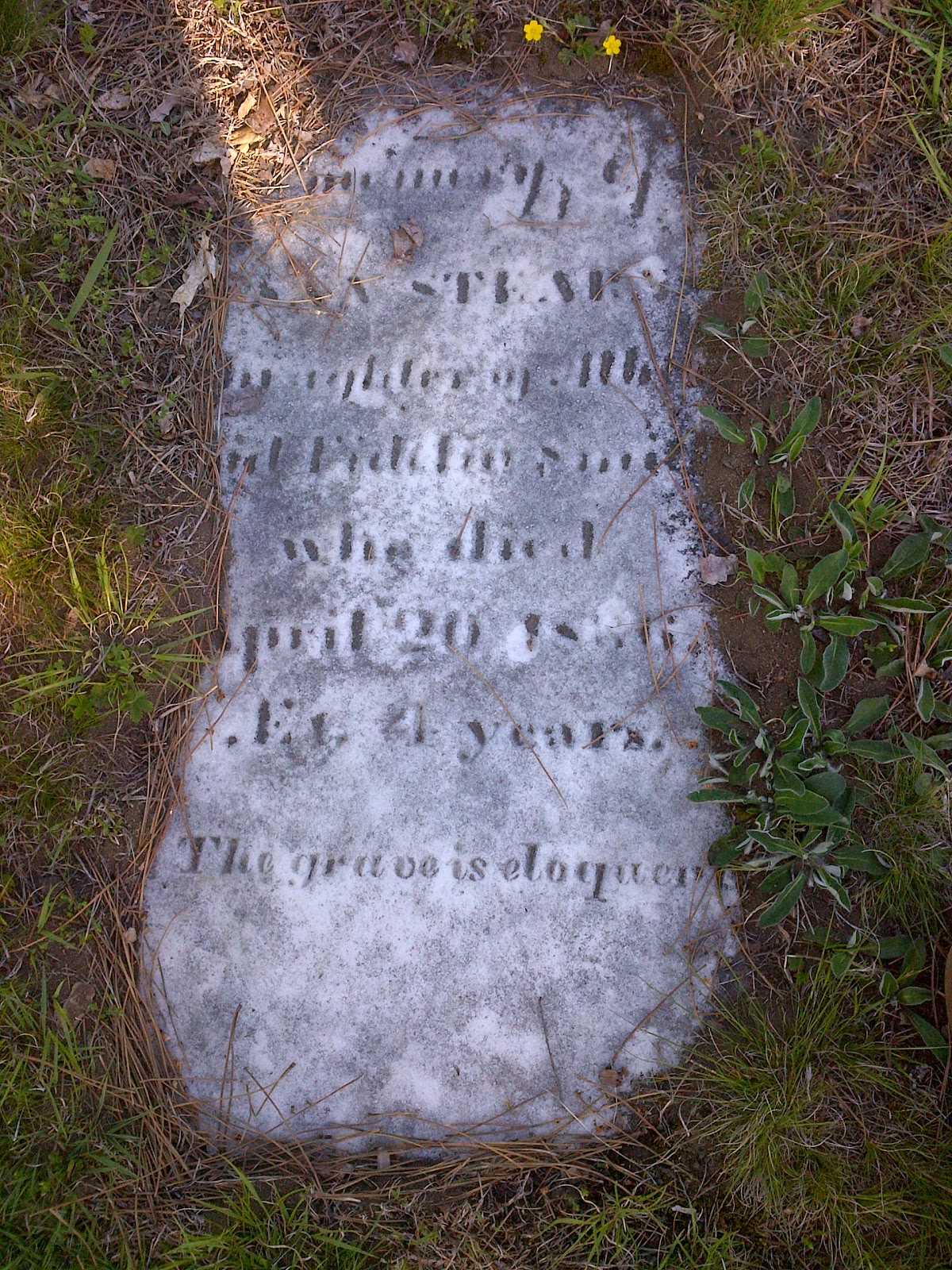
That was something that I recently saw on a nineteenth century grave marker in Leominster, MA.  The grave marker commemorates the death, in 1836, of a 4-year old girl named Susan.  The marker doesn't tell much of Susan, just the date and that her family felt compelled to inscribe her stone with "The grave is eloquent."

"The grave is eloquent."

Were they devastated by her death, and saw the hopeless silence of the earth the telling state?

Was she the victim of lingering pain, and the grave the peace she was released to?

Were they Christian, and saw the expressed hope of Christ's empty tomb as their prayer for reunion at the resurrection?

"The grave is eloquent."

We don't know much about Susan, just her age at passing, where she was interred and that someone thought that more than just the dates were called for, but chose to ponder other than her brief life here.

"The grave is eloquent."

This is what Susan's family, those responsible for her in death, as in life, felt was right. 

Right for her. 

Right for them.

Today, there is controversy over the burial of a 21st century person.  One Tamerlan Tsarnaev.

There were protests outside the funeral home that accepted Tsarnaev as soon as the location was made public.

Calls for burning the ashes and spreading them randomly.

Calls for burial at sea.

Statements from civic leaders that he should not be buried "here," for almost any value of "here" in the U.S.

The funeral director has inquired all across the country, but the answer is always "not here."

Very little thought is given to what would feel right for the family. 

Those who knew the little boy Tamerlan when he was aged four years. 

Who saw him grow. 

Who sent him to school. 

Who took him to worship.

Who saw the evidence of his crime, and the evidence of his death, on television.

I have always been an American.  Usually I've been proud of that.  Not always, but usually.

This is not a time I'm altogether proud of my nation.

I'm ashamed that both the candidates for U.S. Senate for Massachusetts have said "Not here" instead of  "we grieve with all the families."

This isn't about scoring points in some game of pandering to the bigotry of hate.

Funerals aren't really for the dead, they're for the living.  Those left behind.

We need to have compassion for those families who have lost.

All the families. For all the victims.

Compassion, and mercy, are not weakness, but strength.

The mother of this boy thinks she may want to take the boy back to Russia, where he grew up.  His uncle thinks that he should be buried here, as Tamerlan Tsarnaev made the Unites States his home for 10 years.

By the time you read this, the decision may have been made, and the body interred.

But where, and how, will be a telling sign for us all, as a nation.

A sign of our strength, our compassion, our mercy.

"The grave is eloquent"